
In the vast ocean of materials science, the annealing process is like a shining pearl. It is not only an indispensable part of metal processing, but also one of the cornerstones of modern industrial civilization. Today, let us unveil the mystery of annealing and explore the scientific principles and practical applications behind this ancient process.
What is annealing?
Annealing, in simple terms, is a heat treatment process widely used in materials such as metals and glass.
It heats the material to a certain high temperature so that the atoms or molecules inside it obtain enough energy, the binding force between atoms weakens, the atoms begin to rearrange, and then keep it for a period of time before cooling it slowly. This series of steps can effectively regulate the size, shape and distribution of the grains inside the material, causing significant changes in the microstructure inside the material, thereby achieving the purpose of improving the overall performance of the material.
Specifically, the annealing process can effectively eliminate the internal stress generated by the material during the processing process, significantly increase the plasticity of the material, and make it easier to carry out subsequent processing and molding operations. In addition, annealing can also improve the mechanical properties of the material, such as hardness, strength and toughness. This process further improves the overall performance of the material by changing its microstructure.
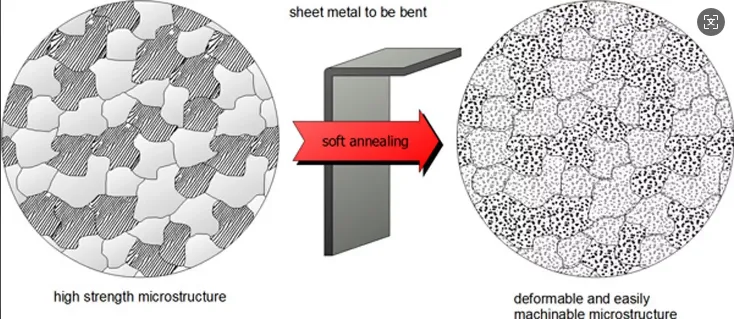
Types of Annealing
1. Full annealing
Full annealing is the most common and widely used type of annealing process. It is mainly suitable for the treatment of carbon steel and alloy steel. Its core purpose is to heat the steel above the critical temperature and keep it at this temperature for a long enough time to ensure that the internal structure is fully transformed. Subsequently, through the process of slow cooling, a more uniform and softer structure is formed inside the steel. This treatment method can not only significantly reduce the hardness of the steel, but also provide great convenience for subsequent mechanical processing, making the processing process smoother and improving production efficiency.
2. Spheroidizing annealing
Spheroidizing annealing is an annealing process that is particularly suitable for high carbon steel. Its main purpose is to transform the carbides in the steel from flake or needle-shaped to spherical distribution, thereby effectively reducing the brittleness of the material and significantly improving its cutting performance. This annealing method is particularly important when manufacturing high-precision parts such as bearings and gears, because it can ensure that the parts have better wear resistance and fatigue resistance during processing and use, and extend their service life.
3. Recrystallization annealing
Recrystallization annealing is mainly used for the treatment of metal materials after cold working. Its purpose is to eliminate the work hardening phenomenon caused by cold working and restore the plastic deformation ability of the material. By heating the material above the recrystallization temperature, the grains inside the metal are re-formed, eliminating the original deformed grains, thereby restoring the original properties of the material. This process not only improves the machinability of the material, but also lays a good foundation for its subsequent heat treatment and forming process.
4. Stress relief annealing
Stress relief annealing is an annealing process specifically used to eliminate residual stress inside metals. This annealing method is usually performed after welding, cold working or casting, and its main purpose is to prevent the material from deforming or cracking due to residual stress during subsequent use. Through proper heating and heat preservation treatment, the stress inside the metal can be effectively released, thereby improving the stability and service life of the material.
5. Stabilization annealing
Stabilization annealing is mainly used for the treatment of stainless steel and other alloy materials. Its core purpose is to stabilize the microstructure of the material by performing a long-term annealing treatment at a specific temperature, thereby improving its corrosion resistance and comprehensive mechanical properties. This annealing method can effectively eliminate the phase change stress inside the material, prevent problems such as intergranular corrosion during use, and ensure that the material can maintain excellent performance under various environmental conditions.
Advantages of annealing
∇Significantly improve plasticity and toughness
During the annealing process, the lattice structure inside the material will be significantly rearranged, and the originally tight grains will gradually grow and become more uniform. This process is like a comprehensive “flexible transformation” of the material, making it softer as a whole, making it easier to form and operate in the subsequent processing. In addition, the toughness of the material will also be greatly improved. For those parts that need to withstand frequent impacts and repeated stresses, this enhanced toughness is undoubtedly a crucial feature, which can effectively extend the service life of the parts and improve their reliability.
∇Effectively eliminate internal stress
During the manufacturing and processing of materials, due to the influence of various external and internal factors, certain internal stresses are inevitably generated. These “forces” hidden inside the materials are like potential time bombs, which may cause the materials to deform or even break at any time, seriously affecting the quality and safety of the products. Annealing treatment is like a brilliant “stress relief master”. Through a slow and uniform cooling process, it gives the material enough time to gradually release these internal stresses, thereby ensuring the dimensional stability of the product, improving its long-term reliability, and avoiding various problems caused by the accumulation of internal stress.
∇ Optimize conductivity and magnetism
For certain metal materials, annealing can not only improve their mechanical properties, but also play an important role in optimizing electrical conductivity and magnetism. Through annealing, the internal microstructure of the material is optimized, and the migration path of electrons becomes smoother, thereby significantly improving electrical conductivity, which is undoubtedly a great benefit for the manufacture of electronic components. At the same time, annealing can also improve the magnetic properties of the material, making its application in electromagnetic equipment more outstanding, significantly improving the overall performance of the product, and providing strong support for technological progress and product upgrades in related fields.
Annealing Applications
Metalworking
In the field of metal processing, annealing can effectively eliminate the internal stress generated by the metal during the processing, thereby significantly improving the metal’s microstructure and making it more uniform and stable. This improvement not only helps to improve the mechanical properties of the metal, but also extends its service life. For example, in the process of manufacturing automotive parts and aerospace components, the annealing process is a key link to ensure that these parts have sufficient strength and durability. Metal parts that have not been annealed are often prone to stress concentration and structural defects, which affect overall performance and safety.
Semiconductor Manufacturing
Annealing technology also plays an indispensable role in the semiconductor industry. Annealing is mainly used to repair lattice defects, which are often caused by high-temperature processes or doping processes. By precisely controlling the temperature and time during the annealing process, the integrity of the lattice structure can be effectively improved, thereby improving the performance and stability of the transistor. Optimizing the electrical properties of semiconductor materials is crucial to the production of high-performance electronic devices. Whether it is a smartphone, computer chip, or other high-end electronic device, the annealing process is a key step to ensure its high performance and reliability.
Glass Manufacturing
In the field of glass manufacturing, the annealing process also plays an irreplaceable role. Glass annealing is to eliminate the thermal stress inside the glass by precisely controlling the cooling rate to prevent it from breaking due to stress concentration during use. The annealing process is particularly important when manufacturing large glass plates or glass products with special shapes. Reasonable annealing treatment can not only improve the mechanical strength and heat resistance of the glass, but also ensure its surface finish and transparency. Whether it is architectural glass, automotive glass, or high-end optical glass, the annealing process is a key link to ensure its quality and performance.
Conclusion
The above is a brief introduction to the annealing process. If you are interested in annealing technology and hope to find the best heat treatment solution for your product, please contact us. Our professional team will provide you with customized annealing services to help your product achieve unprecedented performance levels.