
We are surrounded by various patterns and colors, from billboards in the streets to clothes and household items in daily life. These pleasing patterns are inseparable from an ancient and magical printing technology – screen printing. As a printing process with a long history, screen printing still occupies an important position in the field of modern printing due to its unique production principle and wide applicability. Today, let us take a deeper look at how this ancient technology ingeniously combines art and technology.
How Screen Printing Works
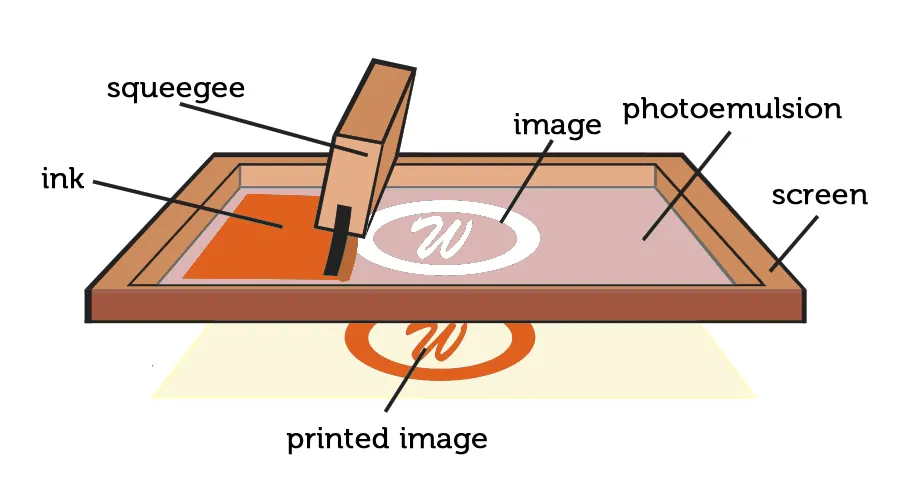
What makes screen printing unique is that it uses a special “screen”. This screen is made of a taut mesh of fine silk (usually polyester or nylon) with holes filled with photosensitive glue. During the printing process, the design pattern is first transferred to the screen through the photosensitive method. The parts not covered by the pattern remain transparent, while the pattern parts are sealed with photosensitive glue.
When printing, the ink is applied to the screen, and then the ink is evenly pressed through the screen with a scraper. Since the mesh holes of the pattern part are closed, the ink cannot pass through, while the unclosed mesh holes allow the ink to pass through, thus accurately transferring the pattern to the material below. This technology can be applied to materials of various shapes and textures, including paper, plastic, metal, glass, textiles, etc. There is a very interesting point.
The history of screen printing
That is, screen printing, which can be traced back to the Song Dynasty in China. It is an ancient skill with a long history and profound heritage. At that time, the hardworking and wise ancient Chinese had mastered the basic principles and methods of screen printing. They cleverly used the means of squeezing pigments to accurately transfer the carefully designed patterns through the mesh-like templates to various flat materials.
As time went by, people discovered that this technology could be used to print patterns on various materials. By the 20th century, with the advancement of technology, screen printing had developed into a mature printing process widely used in advertising, packaging and decoration, clothing printing and dyeing, electronic product manufacturing and other fields, bringing great convenience and rich visual enjoyment to the life and production of human society .
Advantages of screen printing
→Strong adaptability :
Screen printing technology has extremely high adaptability and can be efficiently printed on almost all kinds of material surfaces, whether it is a smooth flat material or a curved material with a certain curvature, it can easily cope with it, showing excellent printing compatibility.
→Textured three-dimensional :
Screen printing can create a variety of effects such as matte, glossy, frosted, and three-dimensional through different inks and printing techniques, and this unique process enables it to achieve a relatively thick ink layer deposition . This thick ink printing method can not only significantly enhance the visual impact of the printed product, but also give it a distinct three-dimensional sense, making the pattern and text more vivid and realistic.
→Bright colors :
The types of inks used in screen printing are extremely rich and diverse, covering various color systems and special effect inks, so it is easy to achieve colorful and eye-catching printing effects, meeting the high standards of color performance of different customers.
→Reduce costs :
For printing projects that require mass production, screen printing has significant advantages in cost control. Its equipment and material investment is relatively low, and its printing efficiency is high, which reduces unit costs, thus bringing considerable economic benefits to customers .
→Long-term durability:
The ink of screen printing has strong adhesion, and the printed products are not only colorful but also durable. Whether it is outdoor billboards or daily items, screen printing can ensure that the color remains stable and not easy to fade during long-term use .
Application fields of screen printing
⊂Advertising industry
In the vast field of advertising industry, screen printing technology undoubtedly plays a vital role. It is not only an important tool for making various advertising materials such as banners, posters, labels and stickers, but also an ideal choice for outdoor advertising production with its excellent color expression and high weather resistance. The color saturation presented by screen printing is extremely high, which can attract people’s attention. At the same time, its excellent weather resistance makes the advertisements remain bright and new for a long time in the outdoor environment, greatly improving the communication effect and durability of the advertisements.
⊂Clothing Industry
In the diverse applications of the clothing industry, screen printing technology is cleverly used to print various clothing patterns. Whether it is a fashionable T-shirt, a vibrant sportswear, or a professional and practical workwear, screen printing can add a unique visual charm to it. The patterns printed by screen printing technology are bright and eye-catching, with great visual impact, and its excellent washability makes the patterns remain bright and fresh after multiple washes, and it is not easy to fade, which greatly improves the beauty and durability of clothing.
⊂Electronics Industry
In the sophisticated and complex electronics industry, screen printing technology also plays an irreplaceable role. It is widely used in the manufacturing process of circuit boards, as well as the marking and identification of various electronic components. With its extremely high precision and stability, screen printing can fully meet the electronics industry’s almost demanding requirements for precision, ensuring that every detail is accurate and correct, thereby ensuring the quality and performance of electronic products.
⊂Art Industry
In the field of art, which is full of creativity and inspiration, screen printing technology also shines. With the help of this technology, artists create exquisite prints, posters and various artworks. The unique texture and powerful expressiveness of screen printing provide unlimited possibilities for artistic creation. Through screen printing, artists can perfectly combine rich colors and delicate textures, giving their works unique artistic charm and profound cultural connotations.
conclusion
Screen printing is not only a technology, but also an art that makes our world more vivid and colorful. Whether you are a designer, engineer or ordinary consumer, understanding screen printing can open a new door for you. If you have special design needs and want to achieve a unique pattern on the product, screen printing is undoubtedly the best choice.
Now, if you are interested in screen printing, or have any questions about screen printing, please feel free to contact us. Our professional team will provide you with the most detailed consulting services and help you turn your ideas into reality. Don’t hesitate, let’s explore the infinite possibilities of screen printing together!