
Chrome plating is a very popular surface treatment technology used in many industries. It can not only make metals shine but also greatly increase the service life of metal parts. The chrome plating process coats the metal substrate with a thin layer of chrome, giving it the advantages of corrosion resistance, wear resistance and smooth polish. In some fields where precision and visual appeal are crucial, such as automotive, aerospace and decorative products, more and more manufacturers choose chrome plating services for their custom components.
Next, let’s understand the basic principles, advantages and applications of chrome plating in various industries.
What is chrome plating?
Before understanding chrome plating, we must first understand electroplating. Chrome plating is a specific application of electroplating. It coats a thin layer of chrome on the surface of metal parts through the working principle of electroplating. The parts that are chrome-plated tend to have a brighter, mirror-like effect. The chrome plating looks like a layer of glittering silver coating, which makes the parts produce more accurate reflections relative to compounds such as polished aluminum. (If you want to learn about electroplating, you can browse the blog on our official website)
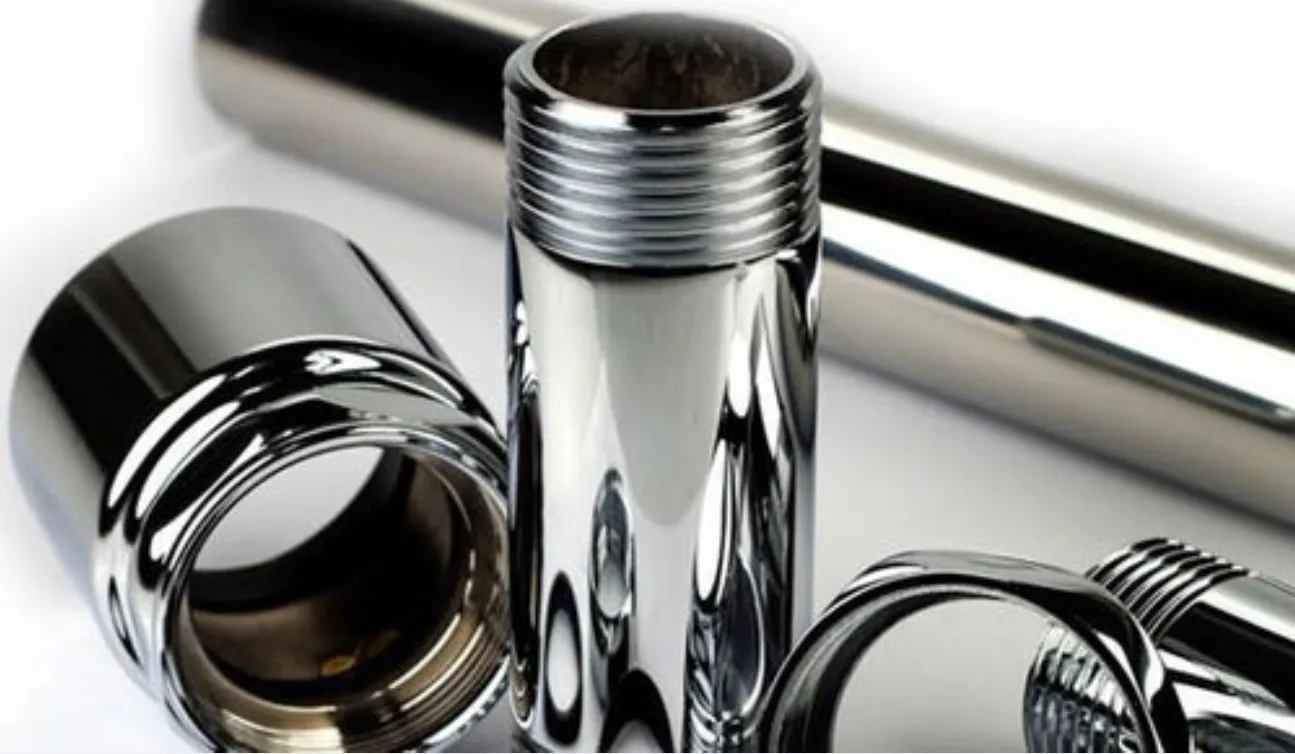
Types of Chrome Plating
ΔDecorative chrome plating
With a mirror-like surface, it can give the product extremely high gloss and beauty, making it look high-end and gorgeous. For example, common car decorative strips, bathroom hardware, etc., after decorative chrome plating, not only enhance the visual effect of the product, but also increase the added value of the product.
Decorative chrome plating is generally thinner, usually between 0.2 – 0.5μm. Thinner plating is mainly to meet aesthetic requirements while controlling costs.
Although decorative chrome plating itself has a certain protective effect on the base metal, its main function is not corrosion protection. It mainly provides a certain degree of protection through the passivation film on the surface and blocking the contact between the external corrosive medium and the base, but the protective ability is relatively limited. In order to improve the overall protective performance, copper plating or nickel plating is often performed before hard chrome plating to form a multi-layer protection system.
ΔHard chrome plating
The hard chrome coating has extremely high hardness, which can generally reach HV800 – 1200, which is much higher than the hardness of ordinary steel. This makes the hard chrome-plated parts excellent in wear resistance and able to withstand high-load friction and wear. For example, in mold manufacturing, hard chrome-plated molds can significantly increase their service life and reduce the risk of mold failure due to wear.
The thickness of hard chrome plating is relatively thick, generally between 20-100μm, and the specific thickness depends on the use requirements of the workpiece. The thicker plating can ensure that during long-term use, even if the surface has a certain degree of wear, it can still maintain sufficient chrome layer thickness and maintain its performance.
Hard chrome plating is often used for parts that have high requirements for wear resistance, corrosion resistance and high temperature resistance, such as engine piston rings, cylinder liners, hydraulic piston rods, etc. In these application scenarios, hard chrome plating can not only improve the wear resistance of parts, but also resist the erosion of high temperature, high pressure and corrosive media to a certain extent, ensuring the normal operation of parts in harsh working environments.
Δ Loose hole chrome plating
The surface of the porous chrome plating layer has many tiny pores or cracks, which are formed by special process treatment (such as porous treatment after hard chrome plating, electrolytic treatment, etc.). This unique structure makes the chrome plating layer have good oil storage performance.
Since pores can store lubricating oil, during the working process of parts, as friction occurs, lubricating oil will seep out of the pores and form a lubricating film on the friction surface, thereby effectively reducing the friction coefficient and reducing the wear between parts. For example, using loose pore chrome plating technology on the inner wall of the engine cylinder can greatly improve the working efficiency and reliability of the engine and extend the service life of the engine.
It is mainly used in mechanical parts with high requirements for lubrication and wear resistance, such as engine cylinders, compressor pistons, etc. On these parts, the loose-pore chrome plating layer can provide good self-lubricating performance while ensuring wear resistance, reduce dependence on external lubrication systems, and improve the operating stability of the equipment.
How to choose a chrome plating solution and precautions
Based on the purpose of chrome plating, the material, shape, size and cost of the product, it is particularly important to choose the right chrome plating solution. Considering the following factors will help you with the chrome plating solution for your product:
Chrome plating purpose :
⇒Decorative chrome plating : If the purpose is to enhance the gloss and beauty of the product appearance, enhance the corrosion resistance to achieve decorative effects, such as automotive decorative parts, bathroom hardware, etc. At this time, attention should be paid to the brightness and uniformity of the chrome plating layer. Ordinary chrome plating technology can be used, which can form a bright, smooth and well-adhesive chrome plating layer on the surface of the workpiece.
⇒ Functional chrome plating : If you want to improve the surface hardness, wear resistance or repair the size of parts, such as mechanical parts, molds, etc., hard chrome plating is the best choice. This process can obtain a chrome plating layer with high hardness and good wear resistance, effectively improving the service life of parts.
Workpiece material :
⇒Steel material : It has good compatibility with chrome plating on steel workpieces and is applicable to most chrome plating processes. However, since steel is prone to rust, strict degreasing and rust removal is required before chrome plating to ensure that the chrome plating layer is well bonded to the substrate.
⇒Aluminum alloy material : Aluminum alloy surface has dense oxide film, and special pretreatment is required before chrome plating. Usually, degreasing and alkaline etching are carried out first to remove oil stains and natural oxide film, and then zinc immersion or chemical nickel plating is carried out to form a transition layer to enhance the adhesion of the chrome plating layer.
⇒Copper and copper alloy materials : Copper and copper alloys have high surface activity and are easily oxidized. Before chrome plating, degreasing and pickling should be performed to remove oil stains and oxide films. In order to obtain good bonding strength, nickel plating can be used as a primer before chrome plating.
Workpiece shape and size :
⇒Complex shape workpieces : Workpieces with complex shapes such as deep holes, blind holes, grooves, etc., may have uneven coating thickness due to the limited dispersion ability of the chrome plating solution during chrome plating. In this case, it is necessary to use a chrome plating process with good dispersion ability, such as pulse chrome plating, to improve the uniformity of coating distribution by controlling the current pulse parameters. At the same time, the hanger and anode shape should be reasonably designed to ensure uniform current distribution.
⇒Large-sized workpieces : Chrome plating of large workpieces requires a larger plating tank and sufficient chrome plating solution, and requires high power. When selecting a chrome plating process, consider the stability of the plating solution and the maintenance cost. You can choose a high-stability chrome plating solution to reduce the frequency of plating solution adjustment and maintenance, and reduce production costs. In addition, heating and stirring equipment must be considered to ensure uniform plating solution temperature and composition.
Production efficiency :
In mass production, it is necessary to quickly obtain a qualified chrome plating layer to improve production efficiency. A high current density chrome plating process can be used. Under higher current density, the chrome plating deposition speed is fast, but care must be taken to avoid problems such as burning, and the composition and temperature of the plating solution must be strictly controlled. In addition, the use of an automated production line can improve production efficiency and product quality stability.
Environmental requirements :
⇒Traditional hexavalent chromium plating : The chromium plating effect is good, but the hexavalent chromium is highly toxic and the wastewater treatment cost is high. In areas with strict environmental protection requirements, if this process is adopted, it is necessary to equip complete wastewater treatment equipment to ensure that the hexavalent chromium is discharged in compliance with the standards.
⇒Trivalent chromium plating : An environmentally friendly chromium plating process developed in recent years. Trivalent chromium has low toxicity and simple wastewater treatment. If environmental protection requirements are high, this process should be given priority. However, the trivalent chromium plating process has problems such as limited coating thickness and relatively low hardness, which need to be comprehensively evaluated according to product requirements.
Advantages of Chrome Plating
chrome plating has five main advantages that make it a popular choice in surface treatment processes:
1. High hardness and wear resistance :
The hardness of the chrome-plated layer is relatively high, generally up to 500-1500HV, which is much higher than that of many base materials. This allows the chrome-plated parts to effectively resist wear and extend their service life in a friction environment. Chrome plating on machining tools can improve the wear resistance of the tool, maintain the cutting accuracy and sharpness of the tool, reduce the frequency of tool replacement, and reduce production costs.
2. Corrosion resistance :
Chromium can quickly form a dense oxide film in the air, which prevents further oxidation of chromium and isolates the contact between the external corrosive medium and the base material. Chrome-plated parts can maintain good appearance and performance for a long time in a humid environment containing acids, alkalis, salts and other corrosive environments. For example, after chrome plating, the faucets of sanitary ware are not easy to rust and corrode even if they are in a humid environment for a long time and may be exposed to chemicals such as detergents, and they remain bright and new.
3. Decorative :
The chrome plating layer gives the product a mirror-like luster and high reflectivity, which can present a bright and beautiful appearance. This luster is not only beautiful, but also improves the texture and grade of the product. After chrome plating on automotive decorative parts such as door handles and wheels, it can significantly improve the overall beauty and luxury of the car.
4. Heat resistance :
The chrome-plated layer can still maintain good performance in high temperature environments. Chromium has a high melting point, and chrome-plated parts can withstand a certain degree of high temperature without deformation or performance degradation. In some high-temperature working environments, such as the valves and exhaust pipes of internal combustion engines, chrome plating can improve their oxidation resistance and thermal fatigue resistance at high temperatures, ensuring that the parts work normally in high-temperature environments.
5. Low cost :
When chrome-plated parts are partially worn or damaged, they can be repaired by re-chrome plating to restore the original performance and appearance of the parts. Compared with replacing the entire part, chrome plating repair costs are lower and takes less time, which can effectively save resources and costs.
Application areas of chrome plating
♦ Automobile industry:
Many exterior parts of automobiles, such as grilles, door handles, and wheels, are chrome-plated to give them a shiny appearance, enhance the overall aesthetics and class of the automobile, and attract consumers to buy. In addition, key engine parts, such as piston rings and valve tappets, are hard-chrome-plated to improve their wear resistance and corrosion resistance, extend the service life of the engine, and ensure that the engine can operate stably under harsh conditions of high temperature, high pressure, and high speed.
♦Mechanical Manufacturing:
Plating hard chrome on the surface of various molds such as injection molds and die-casting molds can effectively improve the demoulding performance of the mold, reduce the adhesion between the mold and the molding material, and at the same time improve the wear resistance of the mold and reduce the wear rate of the mold, thereby increasing the service life of the mold and production efficiency and reducing production costs.
♦ Electronic appliances:
The housing, knobs, buttons and other parts of electronic equipment can be chrome-plated to improve the appearance and texture of the product, making it more modern and fashionable, and enhancing the competitiveness of the product in the market. At the same time, hard chrome plating on some electronic connectors and contacts can improve their conductivity, wear resistance and corrosion resistance, ensuring the stability and reliability of the electrical connection of electronic equipment during long-term use.
♦Aerospace:
Hard chrome plating can improve the corrosion resistance and wear resistance of key parts such as blades and landing gear of aircraft engines in harsh environments. For example, engine blades work in high temperature, high pressure, high-speed airflow and gas environments containing corrosive substances. Hard chrome plating can effectively protect the blades, extend their service life, and ensure the safe and reliable operation of the engine.
Environmental issues and countermeasures of chrome plating
∅Chromic acid mist emission : During the chrome plating process, oxygen is generated on the anode. When a large number of oxygen bubbles escape from the surface of the electrolyte, they carry small droplets of chromic acid to form chromic acid mist. Chromic acid mist is highly corrosive and toxic, which can cause serious harm to the health of operators, such as respiratory diseases, skin allergies and even cancer, and also pollute the surrounding environment.
∅Chromium-containing wastewater discharge : ThEnvironmental issuese chrome plating process generates a large amount of chromium-containing wastewater, which contains heavy metal pollutants such as hexavalent chromium ions. Hexavalent chromium is highly toxic and carcinogenic. If it is discharged directly without treatment, it will cause serious pollution to the ecological environment such as soil and water bodies, affect the survival and reproduction of aquatic organisms, and ultimately threaten human health through enrichment in the food chain.
√Countermeasures:
Currently, the commonly used methods for treating chromium-containing wastewater include chemical reduction, ion exchange, and electrolysis. The chemical reduction method is to reduce the hexavalent chromium in the wastewater to trivalent chromium, and then remove the chromium ions through precipitation and other methods; the ion exchange method is to use ion exchange resin to adsorb and exchange the chromium ions in the wastewater, so as to achieve the purpose of removing chromium ions; the electrolysis method is to use electrolysis to make the chromium ions in the wastewater undergo oxidation-reduction reactions on the electrode surface, thereby achieving the removal and recovery of chromium ions. Through these treatment methods, chromium-containing wastewater can be treated to meet the standards and then discharged or reused, reducing pollution to the environment.
HenDa’s Chrome Plating Service
If you are interested in chrome plating or would like to add a shiny coat to your product, please contact us today. We provide professional chrome plating services, whether it is a small batch customization or a large-scale production task, we can meet it.
In order to better understand your needs, we provide free consulting services, please leave your contact information and contact us!