
Nowadays, stainless steel is everywhere in our lives. In people’s eyes, stainless steel is strong and corrosion-resistant, but is it really so reliable? Of course, even stainless steel cannot completely resist corrosion. As time goes by, the ability of stainless steel to resist corrosion will become worse and worse. The passivation of stainless steel is the key process to give it a new lease of life, which can maximize the service life and integrity of the workpiece.
What is stainless steel passivation?
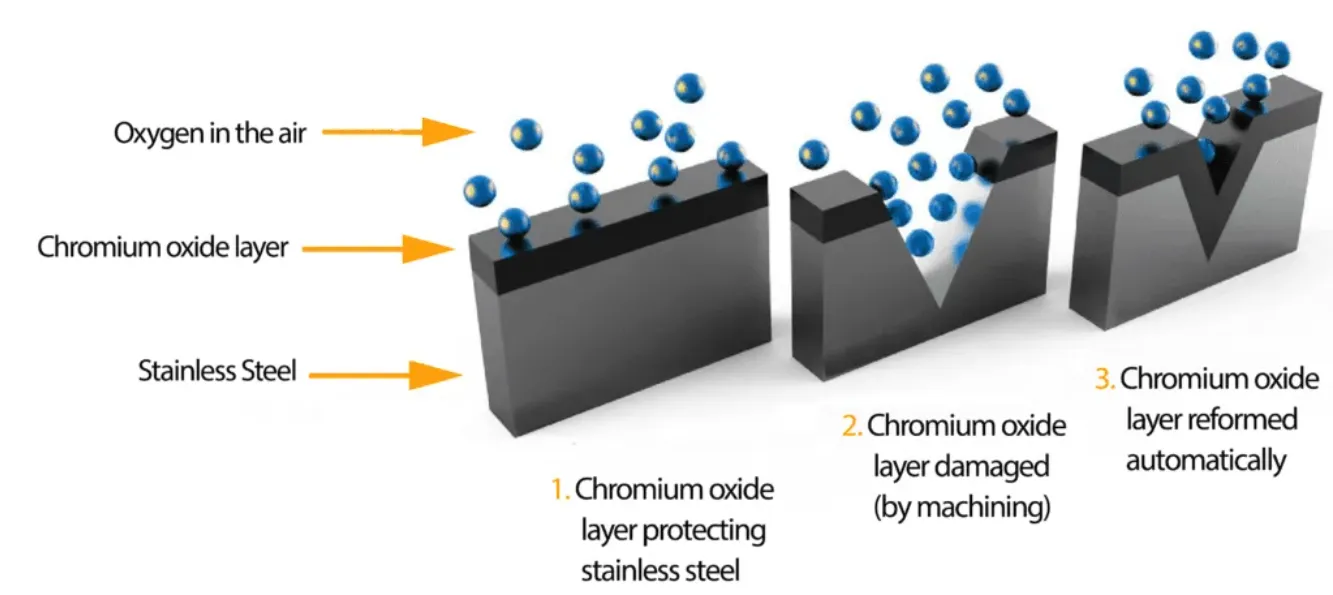
Stainless steel passivation is a process that forms a dense, continuous and stable passivation film on the surface of stainless steel through chemical reaction. This passivation film can effectively isolate the stainless steel matrix from the external environment and significantly improve the corrosion resistance of stainless steel.
When stainless steel is exposed to a specific oxidizing medium (such as nitric acid, chromic acid, etc.) or in the air, the metal atoms on its surface will react with the oxygen in the medium to generate metal oxides or hydroxides. These products will gradually gather on the surface and form a thin and compact film, which is the passivation film. The structure and composition of the passivation film will vary depending on the type of stainless steel, the treatment process and the environmental conditions.
There are various methods for stainless steel passivation. The most common ones are chemical passivation, which involves immersing stainless steel products in a solution containing specific chemical components to promote the formation of a passivation film through chemical reactions; electrochemical passivation uses an external electric field to accelerate the oxidation reaction on the metal surface, thereby generating a passivation film more quickly. Different process methods differ in terms of processing time, passivation effect, and scope of application, and need to be reasonably selected based on specific needs and the characteristics of stainless steel materials.
practical applications, stainless steel passivation has many important meanings. In the industrial field, such as chemical equipment and marine facilities, stainless steel parts that have been passivated can effectively resist the erosion of various chemicals and humid air, extend the service life of equipment, and reduce maintenance costs. In daily necessities, such as tableware and kitchen utensils, passivation treatment can prevent stainless steel from rusting and ensure its beauty and hygiene.
Working principle of stainless steel passivation
Common passivation treatments usually use a passivation solution containing oxidizing substances (such as chromates, nitrates, etc.). During the passivation process, the oxidizing substances react with the metal atoms on the surface of the stainless steel, oxidizing the metal atoms into metal ions, and combining with other components in the solution to form a more complete, dense and stable passivation film on the surface of the stainless steel.
This newly formed passivation film has better corrosion resistance and can effectively prevent further corrosion of the stainless steel. For example, the chromate ions in the chromate passivation solution are highly oxidizing under acidic conditions and can oxidize metals such as iron and chromium on the surface of stainless steel into corresponding metal oxides. These metal oxides gradually gather on the surface of the stainless steel and form a passivation film.
How does stainless steel passivation work?
In general, there are three steps to passivation of stainless steel. Although it looks very simple, this process is very important. Let’s take a brief look at the whole process.
1. Surface pretreatment
The first step is to ensure that there are no contaminants on the surface of the steel parts. Therefore, first grind the parts with a grinder or sandpaper, then use a degreaser to remove grease from the surface of the parts, and finally, according to the degree of corrosion on the surface of the parts, use a pickling solution (hydrochloric acid or sulfuric acid solution) to dissolve and remove impurities such as the oxide layer on the surface of the stainless steel, so that the stainless steel surface can reach a clean state.
2. Passivation
The pretreated stainless steel parts are completely immersed in the passivation solution. There are generally two options for passivation solutions: citric acid and nitric acid.
•Citric acid passivation is a cost-effective and safe way to start the passivation process. It does not emit any toxic gases and has a minimal impact on environmental pollution. However, citric acid is not very popular because it can easily lead to mold growth.
•Nitric acid passivation is another alternative and one that is currently popular in the industry. It provides a more effective molecular distribution, making the passivation layer more durable. However, nitric acid passivation requires longer working hours. In addition, nitric acid is harmful and produces toxic gases.To solve the problem of long processing time, you can combine it with sodium dichromate, but doing so will further enhance toxicity and pollute the environment.
3.Post-processing
Blow the qualified stainless steel parts dry with clean compressed air , avoid leaving them in a humid environment for a long time to prevent the passivation film from being corroded and damaged.
After drying, the stainless steel parts can be protected and packaged according to the actual use and storage requirements. For short-term storage or transportation, they can be wrapped with plastic film; for long-term storage, anti-rust oil can be applied to the surface and then wrapped with moisture-proof paper or plastic film to extend the protective effect of the passivation film and ensure that the stainless steel maintains good corrosion resistance during subsequent use and storage.
Industry Standards for Passivation of Stainless Steel
manufacturers will follow the ASTM or ASM stainless steel passivation standards. Let us take a detailed look at the subdivision and application of these two standards;
ASTM stainless steel passivation standards :
•ASTM A967 : This is a standard specification widely used for chemical passivation of stainless steel parts. It describes in detail the passivation process of different types of stainless steel, such as austenite, ferrite, martensite, etc., in various application scenarios. For austenitic stainless steel, the surface must be clean before passivation treatment, without impurities such as oil, iron filings, etc., and can be cleaned with a suitable organic solvent.
The standard also stipulates the inspection method of the passivated product, such as using the copper sulfate drip test to detect the quality of the passivation film, requiring that within a certain period of time (such as 30 seconds), no copper precipitation should occur at the dripping point, so as to verify whether the passivation treatment has effectively improved the corrosion resistance of stainless steel.
•ASTM B322 : The focus is on evaluating the performance of stainless steel in a specific corrosive environment, thereby indirectly providing a reference standard for the effect of passivation treatment. It simulates corrosion scenarios in a variety of industrial and natural environments, such as chlorine-containing solution environments. The passivated stainless steel specimens are placed in a specified chlorine-containing solution (such as a sodium chloride solution of a certain concentration), and an immersion test is performed under specific temperature and time conditions (such as 35°C, 96 hours) to observe the corrosion conditions on the surface of the specimens, such as whether pitting corrosion, uniform corrosion, etc.
If the corrosion rate of the passivated stainless steel in this test is significantly lower than that of the unpassivated stainless steel, and meets the upper limit of the corrosion rate specified in the standard, it means that its passivation treatment has met certain requirements in improving corrosion resistance, which indirectly reflects the effectiveness and compliance of the passivation process with the standard.
AMS Stainless Steel Passivation Standards :
•AMS 2700 : This standard has strict and specific requirements for the passivation treatment of stainless steel materials used in the aerospace field. Due to the extremely high requirements for safety and reliability of aerospace components, the standard stipulates that before passivation treatment, stainless steel parts need to undergo high-precision surface pretreatment to remove any tiny defects or impurities that may affect the passivation effect. The pretreatment process may include fine mechanical grinding, ultrasonic cleaning, etc. During the passivation process, the purity, ratio, temperature, time and other parameters of the passivation solution are more accurately controlled. For example, the passivation solution may need to be prepared with high-purity reagents and processed under precisely controlled temperature (such as 55±2°C) and time (such as 45±5 minutes) conditions to ensure that the formed passivation film has excellent protective properties and stability .
For inspection after passivation, in addition to routine appearance inspection and corrosion resistance testing, non-destructive testing techniques (such as fluorescent penetrant testing, ultrasonic testing, etc.) are also used to detect whether there are internal defects in the passivation film to ensure the quality and safety of aerospace components.
•AMS 2701 : Mainly focuses on the passivation treatment standards for stainless steel parts used in high temperature environments. This standard specifies the formula of passivation liquid suitable for high temperature environments, and usually some special high temperature resistant additives are added to enhance the stability of the passivation film at high temperatures. During the passivation treatment, in addition to controlling the conventional temperature and time parameters, it is also necessary to consider the effects of heating and cooling rates on the quality of the passivation film.
In the high temperature environment simulation test, the passivated stainless steel specimens are placed in a specified high temperature environment (such as 500-800℃), and a gas with a specific composition (such as simulating the engine exhaust composition) is introduced. After a certain period of time (such as 200 hours), the integrity and corrosion of the passivation film on the surface of the specimen are observed. If the passivation film can still maintain good protective performance and no serious peeling, oxidation and other phenomena occur, it means that the passivation treatment meets the requirements of the AMS 2701 standard for stainless steel passivation in high temperature environments, and can meet the requirements for the corrosion resistance of stainless steel parts in relevant high temperature application scenarios.
Of course, the above are just some common and commonly used standards. If you want to know more detailed stainless steel passivation standards to customize your products, please contact us as soon as possible.
Derivatives of stainless steel passivation
The essence of passivation is a process that converts the metal surface into a state that is not easily oxidized, thereby slowing down the corrosion rate of the metal . So, in addition to stainless steel, are other metal materials also suitable for passivation? Of course, let us understand the passivation process of the following common metal materials;
•passivation of Aluminum : The oxide film naturally formed on the surface of aluminum is thin and loose, and its protective performance is limited. Through chemical passivation treatment, such as the chromate passivation process, a dense, continuous and firmly bonded passivation film can be formed on the aluminum surface. This film not only improves the corrosion resistance of aluminum, but also enhances the adhesion of subsequent coatings to the aluminum substrate.
•passivation of Copper : Copper is prone to patina in humid air. Passivation treatment with benzotriazole (BTA) and other passivating agents can form a stable protective film on the copper surface to inhibit copper oxidation. Brass can also be passivated to prevent dezincification corrosion and surface discoloration. Passivation solutions containing molybdate, tungstate, etc. are usually used to form a passivation film on the brass surface to improve its corrosion resistance.
HengDa: Professional passivation stainless steel fabricator
In manufacturing services, choosing the right supplier is very important. HengDa is committed to any manufacturing service from parts production to stainless steel passivation. We always ensure quality and implement strict standards to achieve results consistent with customer requirements.
From stainless steel passivation to all other surface treatments, HengDa’s team can handle all your requirements. Our professional engineers are always available to provide you with reference suggestions to ensure that you choose the right material and the right process. The efficient production team will deliver the results in the shortest time.